
Mind Games
- January 2010
- Climb
Hey Steph,
I am not sure if you have had an experience like this, but you seem like you would be a likely source for some helpful advice. I took a 70 foot fall on Teewinot in the Teton Range 2 months ago, and luckily came away with only a concussion and a torn hamstring, in addition to some bumps and bruises. I was very, very lucky. I haven’t climbed since then, and I am really wanting to get back out. The desire and psych is all there, but mentally, I feel pretty nervous about getting above gear again. I was wondering if you have ever had something like this happen, and what you did to deal with it; or if not, I at least wanted to see if had any advice! Hopefully I will be out there soon.
Thanks,
Van
Dear Van,
I’m steadily working my way through a big pile of fantastic letters like yours, so it’s been a couple months since you wrote. I sincerely hope the torn hamstring is better, and you are feeling like yourself again. I know hamstrings can linger for a long time, though. I tore mine once years ago while doing a heel hook in Hueco Tanks, and it just took forever for it to stop hurting. Getting concussions is never a good thing either. I know, though, that the psychological damage can be even more lingering. It is really hard to jump back in when your last memory from a fun day out turned into a memory of “oh S#!%” and lots of pain and downtime. I’m glad you are mostly okay, because that sounds like it was a massive whipper.
This kind of fear, returning post-injury, is somehow even stronger than that innocent, new-to-the-sport fear. Because now you know what happens when things actually do go wrong. It’s no longer a vague, “oh what if” fear. But like any fear, I think the recipe is the same. Consistent practice is the way to tame that fear. The key thing is not to be in a big rush. You have a lot of memories of where you were, physically and mentally, before the scary accident, and you can’t help but feel you should be able to just “get over it” and get right back there immediately. When you can’t, you may get frustrated, which just compounds things.
Personally, my most serious accident caused 3 fractures in my sacrum, along with torn rib intercostals and an elbow bursitis (the last 2 hurt the most!). I fractured my sacrum in a base jumping accident, landing my parachute in bad wind conditions in a very rugged spot. I started skydiving as soon as I was recovered enough (skydiving is safer and has much easier landing situations than base jumping), and the first few weeks were pretty terrifying. Every time the ground started coming up, my brain wanted to panic, remembering the seconds just before impact when I was hurt. Those scary jumps weren’t really that much fun, but I knew how much fun it would be when I wasn’t being controlled by fear. So I just kept at it, and eventually, the fear went away.
I’ve had other accidents and injuries too. But in a strange way, I have always enjoyed recovering from an injury, because there is a very satisfying daily and weekly and monthly progression in the experience. So if you can step back a little and adopt that mindset, you will not be frustrated by the bit of time it is going to take to get your head back together after your climbing mishap. Actually, it is just another fun opportunity that climbing has to offer, to experience the satisfaction of progression. Personally, I believe that’s the real reason climbing is so appealing to people –because it is a great vehicle to achieve that feeling of progression.
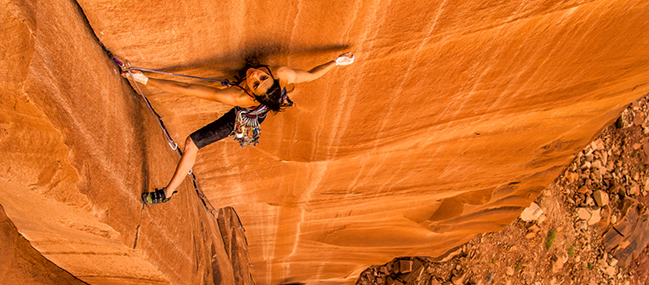
Take it easy on yourself, and listen to yourself. Yes, there is going to be a certain level of fear that will ultimately need to be ignored to step forward, if that’s what you really want to do. But you don’t have do it all in one day. Take baby steps, first going out toproping a lot, until you are confident in your actual climbing skills again. Then start doing easy leads. Don’t stress the timeline…life is long, and hopefully your climbing life will be too. At some point, you will find yourself two inches above a piece of gear or a bolt, trying to do a move that feels like you could fall, and you will be consumed by irrational panic. This is when you get to deal with the fear. In this moment, there is almost no way to actually get hurt (as opposed to the 70 foot whipper you took), and you will have to ignore the fear and go on. At some point, when you are ready, that is the strength you will have to practice, when you will have to walk past the fear, knowing you are not in real danger and merely controlled by fear. The more times you do this, which is indeed a baby step, the bigger the steps will get.
I hope you are back on track and enjoying the sharp end again,
🙂 xxSteph






I actually thought you meant “leading” as in being responsible for other people when you tweeted this.
But Van, this is a truly grand question. And Steph, a good discussion (although there is one thing I really disagree with…)
I’d like to add something from another perspective. I’ve almost died twice (that I know of), and as a fire fighter in Boulder I have been involved in many rescues and recoveries, of fallen climbers, car accidents, kayak misadventures, etc. It takes me at least a couple weeks to process each one, and so Van, take your time. This whipper was a serious event, possibly one of the most significant in your life. Let it change you.
This doesn’t mean quit climbing, or even stop leading. But as Steph put it, you are now fully aware of the severe consequences of what you do. That will take some getting used to.
Steph, your advice on how to baby step your way back into climbing is truly excellent. This will take you far on your way to getting back on the horse. But there another part to recovery.
Take that glow/excitement/appreciation for life that you gained from this experience and recycle it back into your adventure. As you slowly work your way back into climbing and leading don’t “learn to ignore the fear” but let it become your friend, so that when you feel it, you think “oh yeah! Thanks for the reminder. This is LIFE, and I love it!” rather than “oh shit, gonna die, gotta go down.”
And Van, it doesn’t seem like you have this problem at all, but talk to people as you progress in the journey! As Steph put it climbing is about feeling the vehicle of progression. People are happy and excited to help someone make progress, so keep the conversation alive.
And don’t forget about the gym! A few good intentional falls on some bomber hardware with someone you really trust on the other end of the rope can really help with the “treating fear as a friend” part.
Larkin
Thanks for your perspective Larkin, this is a lot like what my friend Chris tells me he does, with base jumping. He says that rather than allowing fear to take over his mind, he consciously puts it “beside” his brain. So fear is still there, but it’s not controlling him.
For me, I can’t allow it. When I feel fear, I need to erase it in order to remain safe and functional when doing something dangerous. So I spend a lot of time thinking about it during the times when I’m not actually doing potentially scary things, but in those moments, I can’t allow it to affect my activity. It’s interesting to compare methods of handling fear.
🙂 Steph
Hey guys, thanks a ton for your replies and advice. I’ve gotten above gear since I wrote you steph, and am back to climbing pretty near my former level. I place more gear now, but I think that is a change that needed to happen. Best Wishes.
Van
I love this post. I had an accident as well four years ago and have done little to no leading on gear since. I had to take a step back and realize that I was still a beginner and to take it slow. Toprope, follow climbs, lead in the gym a lot, until my confidence returns. Climbing is a scary activity with a very steep learning curve, and with little or no room for error unlike other sports.
I realized I don’t have to be leading 5.9s in a couple of years after starting climbing. It’ll happen when I’m ready. This used to bother me a great deal being a very goal-oriented success seeking person, but after a few frustrated sessions I learned to embrace this mentality. Progress does not come on any adapted deadline for any hard, successful climbs you’ve mapped out for yourself. It’s kind of like martial arts.
Another enlightening aspect of climbing came when I saw some experts on video red-pointing some climbs. What I didn’t know was that they had often practiced that same route multiple times before getting it right, probably more times than I had climbed in my entire life. And they practiced all the time, everyday.
Both those realizations gave me some perspective on climbing and changed my attitude toward climbing. I didn’t have to be embarrassed about my lack of skills/abilities anymore, and it was ok to practice and work towards them rather than expect them to come to me quickly and get frustrated.
I know I’d probably be a lot further along if I came to this realization before.