
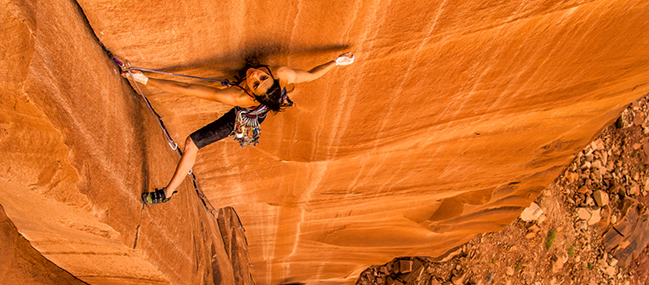
Tips for Women Climbers
Hi Steph,
I have the honor of teaching a women’s climbing class at a local rock gym, and am wondering if you have any thoughts or insight about how to orient my lessons specific to women’s climbing. I’m excited about teaching a class with this emphasis, especially since a gal can’t take a pee in this gym without looking at a poster of a half-naked male rock star. I think it’s important for women to know that there are differences in climbing for each gender, and to not get discouraged when they can’t muscle up their guy friend’s favorite boulder problem.
I have a couple ideas in mind, but am curious to know if you have any recommendations for drills or lessons.
Also, in addition to modifying the bathroom decor, I wonder if you have any other suggestions for making a gym more user-friendly for the females.
Thanks so much for all that you do.
-Jess Brown
Juneau, Alaska
Dear Jess,
Easy part first: if you don’t like guys in the girls’ room with your bathroom posters, give me your address and I’m happy to send you some!
I hope your classes have been going well, and that the women are psyched and learning a lot from you! I like what you are saying, about climbing being different for everyone. For sure, climbing is different for EVERYONE, and not just based on gender. But I agree with you, that when starting out, climbing can seem frustrating for women, because upper body strength can cause immediate problems, especially in a climbing gym.
It’s true that women naturally carry and create less upper body muscle than men. However, it’s also true that strength to weight ratio is really what matters in climbing. Here’s what I’ve noticed and pointed out to people, when teaching rock climbing. I’ve noticed that when people start climbing, if they happen to have a lot of upper body strength to begin with, they often don’t need to learn precise footwork and body movement at first. So a plateau can happen relatively quickly, which can force them to back up a little. Conversely, when people start climbing and have less upper body strength, they have no choice but to work it more with footwork and balance. They won’t see those instant results, but they will be developing the more important climbing skills from the start.
If you share this idea with the women in your class, you will be showing them a way to focus on the positive side of their experience with climbing, and they will really get motivated. They will no longer be annoyed when they watch someone muscle up a climb they can’t do in those first few climbing sessions. Instead, they will notice how much footwork and body movement they are using to learn how to climb that route, and they will realize that when they do start to build upper body strength, they will be able to progress even more.
The big advantage for women is that when we start climbing, we don’t tend to have as much natural muscle mass as men. So if we train, at all, the strength increase we build has dramatic results, which is always gratifying 🙂
I’m not sure how advanced your classes are. But I have had a few opportunities, when bouldering around with friends, to take beginner climbers off to the side and show them a few very basic things. Again, this is extremely basic, but I have consistently found that beginner climbers benefit a lot by a small demonstration of which part of the shoe to stand on, when using footholds. As experienced climbers, it becomes very natural to stand on the power point of your climbing shoe, the tip of your big toe, or the 2 inch zone of your climbing shoe between the big toe and the ball of your foot. However, for people who are wearing climbing shoes for the first few times, it’s not so obvious. Showing people those parts of the shoes, even placing an empty shoe on footholds to illustrate those power spots, and then actually placing their foot on footholds correctly to demonstrate, always leads to immediate and huge improvements.
For the women who are more advanced, the best thing I was ever taught is the importance of stopping and resting, and training for recovery. This is something you can train for, and I learned it from a French friend of mine, Lise, who was an unbelievable endurance sport climber, the best I ever was privileged to climb with (now she is a yogi martial artist in India). She taught me to train on sport routes or climbing walls by climbing 5 to 15 moves, and then stopping on a jug and taking the time to shake out the arms, one after the other, for as long as it takes to de-pump. She always trained and climbed this way, and she could climb really impressive endurance routes, because she never had to be pumped when climbing into a crux, since she had always made sure to recover along the way, and she was always able to recover after the crux. Climbing this way is also very relaxing and reduces anxiety.
I hope these tips help!
🙂 Steph






Thanks so much for this post! I haven’t been climbing for long, but the mental work it took to become comfortable on the wall or on the mountain was formidable. I always felt less capable than those able to muscle their way up. Now that I’m outdoor climbing (in Yangshuo, China) I realize that footwork is key to most climbs. Perhaps you can muscle up a single pitch but if you forget your feet on a multi-pitch you’re toast!
One of the moments of breakthrough for me was likening climbing to yoga. The day I learned that the downward dog is a resting pose (with your bones stacked up in balance and your muscles relaxing) I came to understand the point of yoga. The balance of climbing is the same. You stretch to the next hold and then find the balancing place so that your bones are doing as much of the work as possible.
Finally, I was fortunate enough to build a bouldering wall in my garage and had a safe place to feel everything that was going on in my body. Just as in intense yoga sessions, emotion stored in your body can release unexpectedly. There were many sessions with the girls in the garage that ended in tears. Sometimes because we couldn’t do it, but also sometimes because we felt beautiful in a new and exciting way.
My daughter amazes me with what she can do every time we go to the gym, so I know you women are sandbagging us men! I am aware of the different mental hurdles each sex faces while at gym. My wife faces self-image and fear of failure and I get trapped in the ego-fest of difficulty and failure. I also have to laugh at the amount of dudes that take their shirt off in the gym. All the time! How can such a positive feeling experience, turn into such a metered event when rock turns to plastic???
I think the most important thing in climbing is to break free of the feelings of comparison, quantitative thought, and competition. Climbing has a problem as a sport because of the modern grading system which has become some kind of ranking system rather than a means of sharing information, and because of the tendency to compare oneself with others. This can be especially problematic with sport climbing, and inside gyms. Whenever I see people becoming frustrated or not having fun, it’s because of this pressure (internal or external) to “succeed” or “achieve” with climbing. We have to back up a little, and remember why we want to go climbing. Climbing is fun, it feels good, it can teach us a lot of important things, it can allow us to enjoy the feeling of personal progression. That’s why we’re doing it. Climbing for a sense of external achievement or competition is destined to stop being fun. If we can learn one thing from climbing, I think that may be the biggest one.
Eh, I take my shirt off all the time too (the sports bra stays on :p). I usually don’t use chalk so if my hands get sweaty I take off a layer 🙂
I think one key is using all the tools available to you. Just because I am a girl doesn’t mean I have to climb “like a girl” all the time. Sometimes footwork is too much work and it’s more fun to just try the dyno, even if it’s not the “right” way to do it or the most efficient.
Oh, and women definitely dial it back when men are around. I’ve been asked to and I’m not even a great climber :/
Dear Ralph,
I am one of those guys that takes his shirt off in a climbing gym along with 50% of other male climbers. I cannot speak for all, but most of the barren guys in my gym do so solely for comfort. It SIGNIFICANTLY reduces perspiration. Not only do we not need to use as much chalk as a result, but we also keep it pleasant for everybody else by not stinking up the building.
I certainly think that it is a bad idea to emphasize gender separation in this wonderful sport. Whether climbing indoors or out I am lucky to be surrounded by wonderful people with a certain sense of unity, without the negativity that “ism” brings. Like Steph emphasized we do not compete with one another. Being in a company of a more skilled climber (whether man or a woman) brings out a feeling of admiration and inspiration, not jealousy and failure which I think are signs of personal issues.
What a lovely & important comment by Leslie, above: “we felt beautiful in a new and exciting way.” 🙂
Thanks, Steph, for your feedback. I think it will most definitely be helpful to pass on. I appreciate that you have both acknowledged that there are some natural differences and tendencies for women, but also emphasized that climbing is unique to every ‘body’ and that we can all benefit from simple yet profound lessons.
I apologize if anyone misunderstood my intention as an exclusive or competitive juxtaposition of male and female climbers. I would, however, like to acknowledge that rock gyms can be intimidating (and sometimes irritating) to walk into as a gal, especially if there is a huge male presence, which is precisely why I want to support more women climbing and feeling comfortable in this environment.
The reason I sought out your advice, as a female climber, is because, let’s face it, males have quite a bit of input in how many women move and manipulate their bodies already. I think it’s a simple, yet radical notion for women to redefine their body images according to themselves or other women. I’m excited to offer women more support and training so that they, too, can explore, challenge themselves, and grow in their own physical and mental strength. I look forward to contributing to a healthy-intentioned climbing community, and sharing the bliss of this activity/sport with others, even if it is rather confined to plastic and pandora for now.
Thanks all, for your comments and interest.
Steph, we would love some posters, sent to:
The Rock Dump
1310 Eastaugh Way
Juneau, AK 99801
Absolutely Jess, I’ll send you some. I think your letter is so great, because it started people thinking about their own experiences and perspectives on all of the topics we were talking about. I’d love to hear how your classes have been going!
🙂 steph
Steph! The posters are awesome- thanks so much! The classes are going great- I’ve been lucky enough to have a fabulous group of women lately who are having a blast and totally getting into it. One of them is deeming climbing the best post-menopausal activity a woman can do. And its great to see a new variety of experience, skill, body types, ages, etc.. come into the gym.
One particular atmosphere enhancement I recently made was changing the music from the typical reggae to some soulful Aretha Franklin sort of stuff. The results were quite tangible.
Thanks again!
That was a very good idea! Thanks for the update–it sounds like you guys are having a great time:)
It’s really great to read this article as I’m about to go for my second climb after several months break. Feel rather distraught thinking about how women are often portrayed in comics, and both mainstream and underground art/media in ways that make men feel powerful/good about themselves, really fuels my desire to take up climbing again and to feel strong and powerful and enjoy being in my body, as a woman. It’s really motivating to hear other women talk about climbing. 🙂
Just stumbled across this article and it has been a very informative read. I am definitely stronger than most beginner female climbers – and my footwork certainly does suck – which I sort of suspected before I read this article – but now i am enlightened.
WOW….big page, not one word/comment about pullups? other strength training and conditioning? A lot of women happen to not be good at it, until they learn. The only way these females will be feeling the gym is “friendly” (if they want to be athletes and not male attention seekers) is doing more pullups. You just can’t go around this, sorry.
What you said: “let’s face it, males have quite a bit of input in how many women move and manipulate their bodies already. I think it’s a simple, yet radical notion for women to redefine their body images according to themselves or other womenlet’s face it, males have quite a bit of input in how many women move and manipulate their bodies already. I think it’s a simple, yet radical notion for women to redefine their body images according to themselves or other women”
Yes, exactly.
This whole thing is horrendous.
And a part of it is women’s INSTALLED PROGRAMMED fear of modifying their body to be muscular and athletic and training very hard.
So, please, embrace weighted pullups. Train for one armed pullups. Train front lever. Train back lever. Train dynos. Do campus boards, peg boards, bachar ladders, legless rope climbs, etc, etc. Don’t be chased out of this territory out of fear to get too muscular or whatever. Will they hate? Yes, may be! But can you live your life submitting to others’ will forever, like a coward?
Enough media and societal brainwash about how women should “look”, “train” and “act”.
NOT be “ladylike”, thanks.
Yeah, in the gym setting, one certainly will have trouble in “breaking from the feeling of comparision”, considering the numbers of males sitting on the floor staring at other climbers (instead of focusing on conditioning between climbs). Ranking, judging, etc…that’s why I train alone. That whole pack mentality in the gyms is sickening.
Not everyone is lucky to have own wall…I wish I had. For me it’s either a long drive to crags or gym filled with males who like to stare at women…no thanks, I’d rather hang my rings in the garage and train on monkey bars as I can’t afford to drive to the crags often…the feeling of Freedom is very important when you train. You can’t have truly full emotional, spiritual, meditative experience out of a training session when there’re unwelcome onlookers around.