
Racking Tips for Crack Climbing
Yes, it is that most awesome time of year, crack season!!!
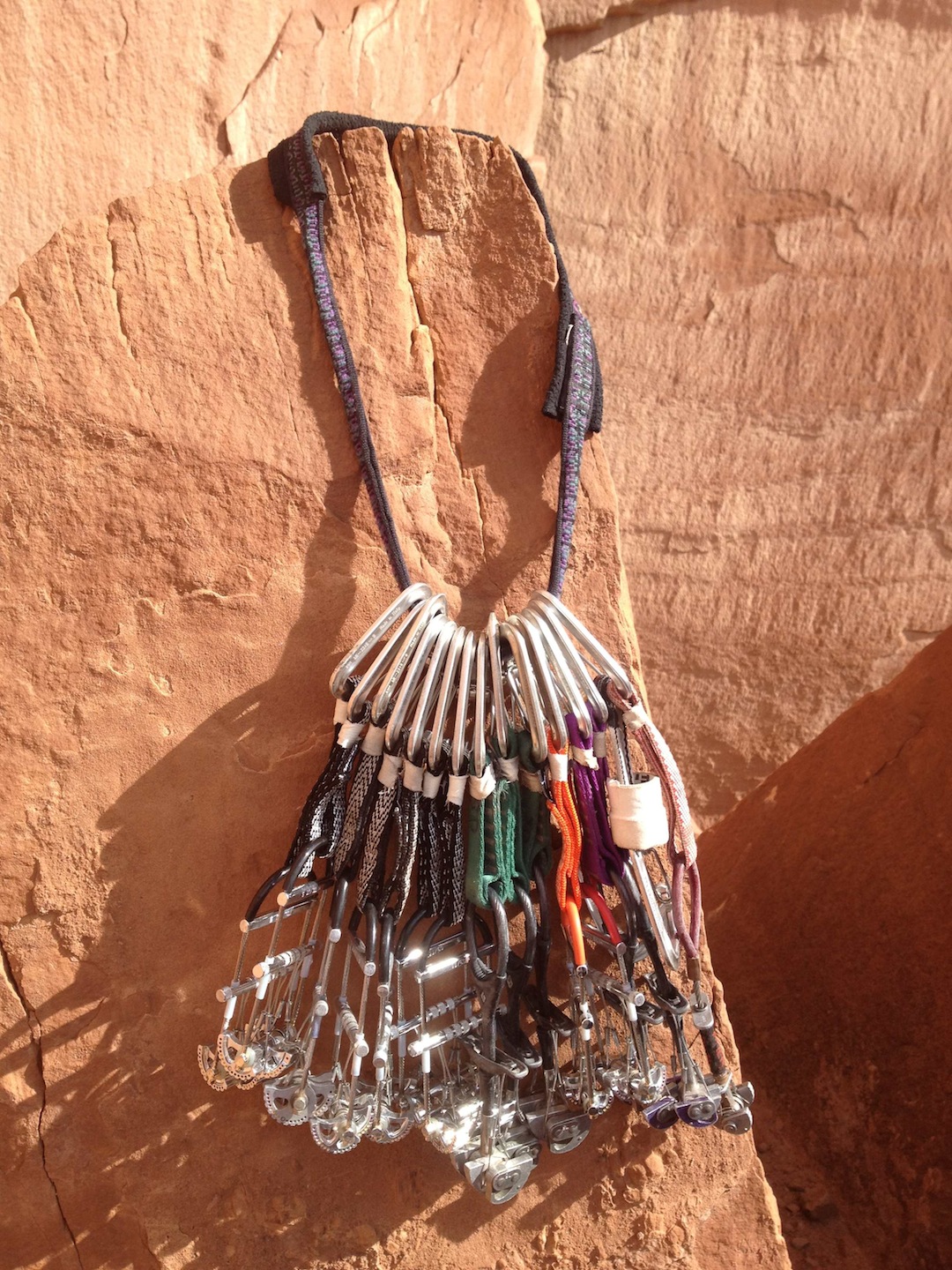
Most of us have a preferred racking style, even down to which way we clip the draws on gear loops (I always clip mine with gate facing out). When climbing cracks, having a consistent, good racking system can make the difference between cruising and flailing.
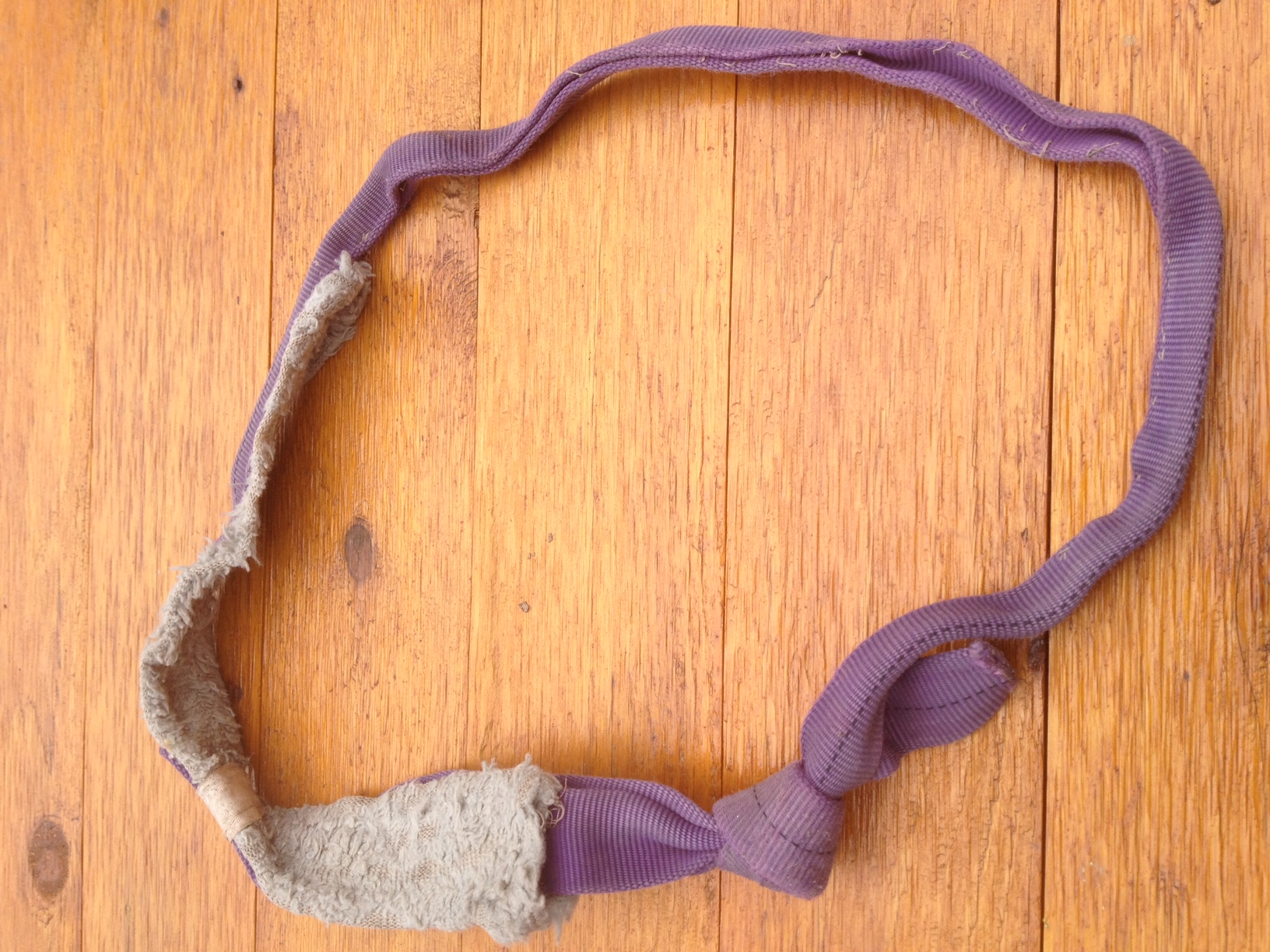
First, you need a gear sling, and it needs to be the right size. For a few years, I thought I “couldn’t use” gear slings, and it took me a pretty ridiculously long time to realize that the reason all the cams kept wedging between my legs was that I was using guy-sized gear slings. (Duh.) It’s not easy to find an extra small or small sling, and at first I just made one out of webbing (closed with a water knot and with some fleece stitched on for padding, so it would be both full strength and comfortable) one day in Camp 4. I still have it, and use it sometimes when I’ve stashed my other one somewhere or can’t find it at the moment…. There are some great memories from that gear sling!
After a while, I lucked out in a gear shop one day and discovered a small size gear sling, and I’ve been using the new one (well, it was new 10 years ago) ever since. Having a gear sling that fits you (this means you need a small one, ladies), will completely change your view of gear slings–I see so many people who insist on harness racking, always, and it does not serve you in the long run. Some desert or wall routes can require 20-30 cams for a lead, along with nuts, draws, slings and biners. Also, harness racking will make your life hell in wide cracks or pitches that suddenly press you against the wall on one side.
I like to use a combination of gear sling and harness racking (with a few exceptions, like short hard finger cracks, and then sometimes I only rack on the harness). Normally, like for regular gear climbing on granite or desert towers, I rack just like anyone else: nuts and then cams from small to big on the sling, with draws and extra biners on the harness, and long slings rigged with single biners looped over my chest.
Climbing splitter cracks, which is not regular, calls for tailoring the rack to the climb. I try to figure out what sizes are happening where on the crack, and then rack the pieces on my sling in that order. If I have a ridiculously monstrous rack of cams, I usually put the big pieces on the sling and the small pieces evenly distributed on gear loops. If I’m trying a crack multiple times, I will make a game plan of which piece gets placed when, and from which side, and organize my rack exactly in order of gear placements. For really hard sends, this is crucial.
For those of us who are smaller and/or weaker than would be convenient, weight matters a lot. More than anything. Leaving the ground with a rack of 28 cams and biners and a rope hanging off you changes the difficulty of the climb. (That’s how many pieces I used on Concepcion, a 200 foot pitch, even with two 40 foot runouts at the top). And since climbing is about weight to strength, if you are a smaller person, you need to get serious about weight reduction of the rack. I use Moses biners on all my cams, and am currently addicted to Metolius Fat cams, because they are light and extremely confidence inspiring on desert sandstone. If you pile up 28 heavy biners and 28 Moses biners and pick them up in each hand, you will notice the weight difference immediately. Same with heavy cams versus light cams.
The weight of the rope can make or break you too, on long pitches. At the top of a 150 foot pitch, the weight of the rope can make it nearly impossible to even shove it in a biner gate with your thumb, especially because you will be pumped already, even if you place at your waist because you can’t pull the weight of the rope up with one hand to clip higher (this happens a lot on the long pitches). So though I don’t like it because it’s scary, I use a very thin rope on super long crack pitches. If there are no edges or places the rope could cut, it is safe, and it can make the difference between being able to get the rope clipped in a biner or not–but it’s scary, because when you fall you take an enormous whipper, especially if it’s at the end of the pitch. On the Salathe, I led the headwall with an 8.9 Serenity. And yes, took some super scary whippers at the very end of the pitch 🙂 But I know I couldn’t have gotten the rope into the biner gates with a heavier rope up there–it just becomes impossible to lift it with your thumb when there is a 150 feet of rope out and you are insanely pumped, even when clipping at your waist.
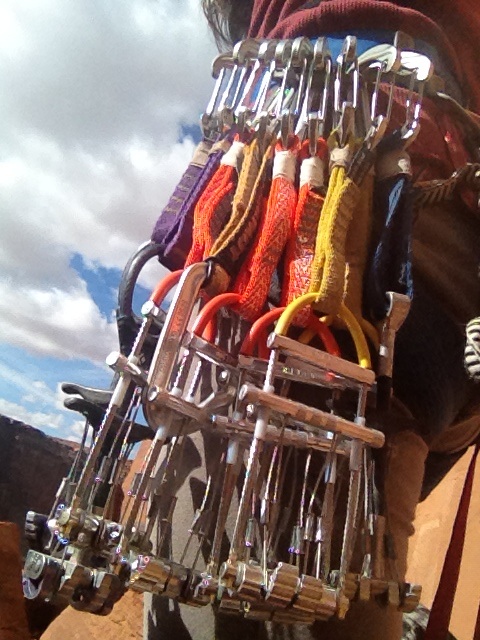
The most important, and also simplest tip, is to tape the cam sling just below the biner. There is nothing more annoying (and desperate), than slamming in a cam off of one arm, while in a layback position, and having the biner flip upside down so you have to spend an extra few seconds (and possibly your chance at getting the rope clipped into it) hanging on and turning the biner around. Believe me, it can make you want to cry. And ruin your send. I have found that inevitably, if I am too lazy to tape one cam, that will be the one that I desperately place from a horrible stance in a crux, and the biner will flip after I place it. Always. Some people think the fixed biner end will be irritating when needing to extend the cam length with a sling, but it is not. Just carry your shoulder-lengths around your chest with a biner already hanging on each one, and then all you have to do to extend the piece is clip the sling to the cam biner. Tape isn’t just for hands 🙂






Nice article Steph. Also, looks like we rack exactly alike, taping biners and all! Enjoy the season.
-Lee Jenkins
PHENOMENAL BLOG POST STEPH. I’M SAVING THIS POST FOR BETA IN THE FUTURE.
NAMASTE.
What if you clip a draw to the cam sling to extend a little. Do you do it behind the tapped portion?
my draws have one end with a loose biner, and one end with a taped or rubber-banded fixed biner. I just take off the loose biner from the draw and clip the cam biner there, if I am extending with a draw.
Haha – I had a homemade gear sling, too! I tried to be super cool and make loops into it, but that didn’t work out so well. Thanks for the great advice and good read.
So, you’re not doing this on the fly, right? That would cost precious seconds, too, no?
And thanks for this post, I found it very helpful.
good, I’m glad! it’s a little faster to extend with a shoulder-length and biner, but you still need somewhat of a stance.
you’re welcome 🙂
You have inspired me to move away from squishing everything onto my harness and adopt the gear sling. It may have been your article or the picture of the fuzzy, home-made gear sling.
Thanks!
Where did you find the small gear sling? I have been looking for one for a while…
It’s an ABC sling–I bought it so long ago, I’m not sure if they are still available? It’s marked size small on it.
Great article! Thanks for the tips. I am currently waiting out a Yukon winter before I put some more mileage on my cams. I’m still a bit of a trad newbie. Can I ask what is probably a silly question? Is there a size of cam that will no longer hold a fall and are designed to be for aid? I’m looking at this chart from Metolius that says cams fail at around 9kN. Does that mean cams that are rated lower than this are just for aid?
[…] Steph, Great article! Thanks for the tips on gear. I am currently waiting out a Yukon winter before I put some more mileage on my cams. I’m […]
First of all, sorry my bad english 😉
Very well described article, I’ll try to translate to portuguese and share here in Brazil.
Best climbings,
Davi Marski – Brazil
Thanks!
do you find that your cams walk more with the taped slings?
No, I haven’t noticed that.
[…] have never tried to rack their gear on a gear sling, however once you get used to climbing with one there’s no going back. Racking on a gear sling makes for faster changeovers at belays, allows you to get gear out of your […]
What about using a big wall type sling? http://www.metoliusclimbing.com/big_wall_gear_sling.html Seems this would be ideal?
this would be kind of the opposite of what I look for in a gear sling. but great for aid climbing big walls routes.
[…] you for posting those articles about small gear and racking on your blog. Also, you got some kick ass clips in movies, I really like the one on the diamond. […]