
Small Cams and Falls
Hi Steph,
Great article! Thanks for the tips on gear. I am currently waiting out a Yukon winter before I put some more mileage on my cams. I’m still a bit of a trad newbie. Can I ask what is probably a silly question? Is there a size of cam that will no longer hold a fall and are designed to be for aid? I’m looking at this chart from Metolius that says cams fail at around 9kN. Does that mean cams that are rated lower than this are just for aid?
Duane
Hi Duane,
Brooke Sandahl is the VP and head of many things at Metolius, and a legendary Yosemite and Smith Rocks climber. I asked him for some clarification on your question, which I wanted to know too! I’m not sure if I’m glad or sad to see that I should continue to be totally gripped when climbing over those tiny pieces in sandstone 🙂 Nonetheless,those littlest grey and purple master cams are a real sanity saver for me–when nothing else fits in the crack except tips of fingers, those give me the confidence to keep going. And when the cams get small, the more the better, for me, beyond the normal desert placement style of every body length: I like to have them just a few feet apart when they are tiny. And if I have to punch it past them, well, then I will not fall 😉 But I still like seeing the rope clipped to something down there….
But onto the real scoop. Here’s what Brooke had to say (thanks Brooke!!):
Cam ratings – Metolius Dec 12, 2011
Not a “silly” question at all. No question is “silly” when it involves life saving equipment.
As an analogy – think of wired stoppers. Look @ the smallest size of say our Astro Nut (# 1 = 2 kN /(450 lbf)…they are micro…tiny little wire for the body, wee little head for the actual stopper portion…doesn’t look like it could hold much…and it can’t (approx. 450 lbf). Look @ a # 10 Astro Nut – way beefier cable, way larger head ( # 10 = 10 kN / 2250 lbf)…so it’s pretty easy to see why one is rated much higher that another. It follows one should use the #1 Astro very judiciously…i.e. only for body weight applications only…it can’t be expected to hold a fall of any consequence. As an example (to give an idea of force) I put our engineer on the load cell and had him bounce test while standing in a aider (simulating a bounce test for an aid placement). He is a beefy Austrian, that weighs about 170lbs and just bounce testing with body weight (not even a rack or other gear on – he could get the load up to well over 400 lbs). In other words he is not that far from reaching the rated strength of the tiny #1 Astro Nut!
For example to give some idea what a kilo Newton ( kN) relates to (1kN = 225 lbf – so a 10 kN rated piece: (10 x 225 lbf = 2250 lbf ) –
The same analogy can be made with cams. As you get to the smaller sizes of cams all the parts must get smaller too. Units below about ¾ of an inch (range of the cam or crack size is what we are referring to here) in size must start using these smaller parts.
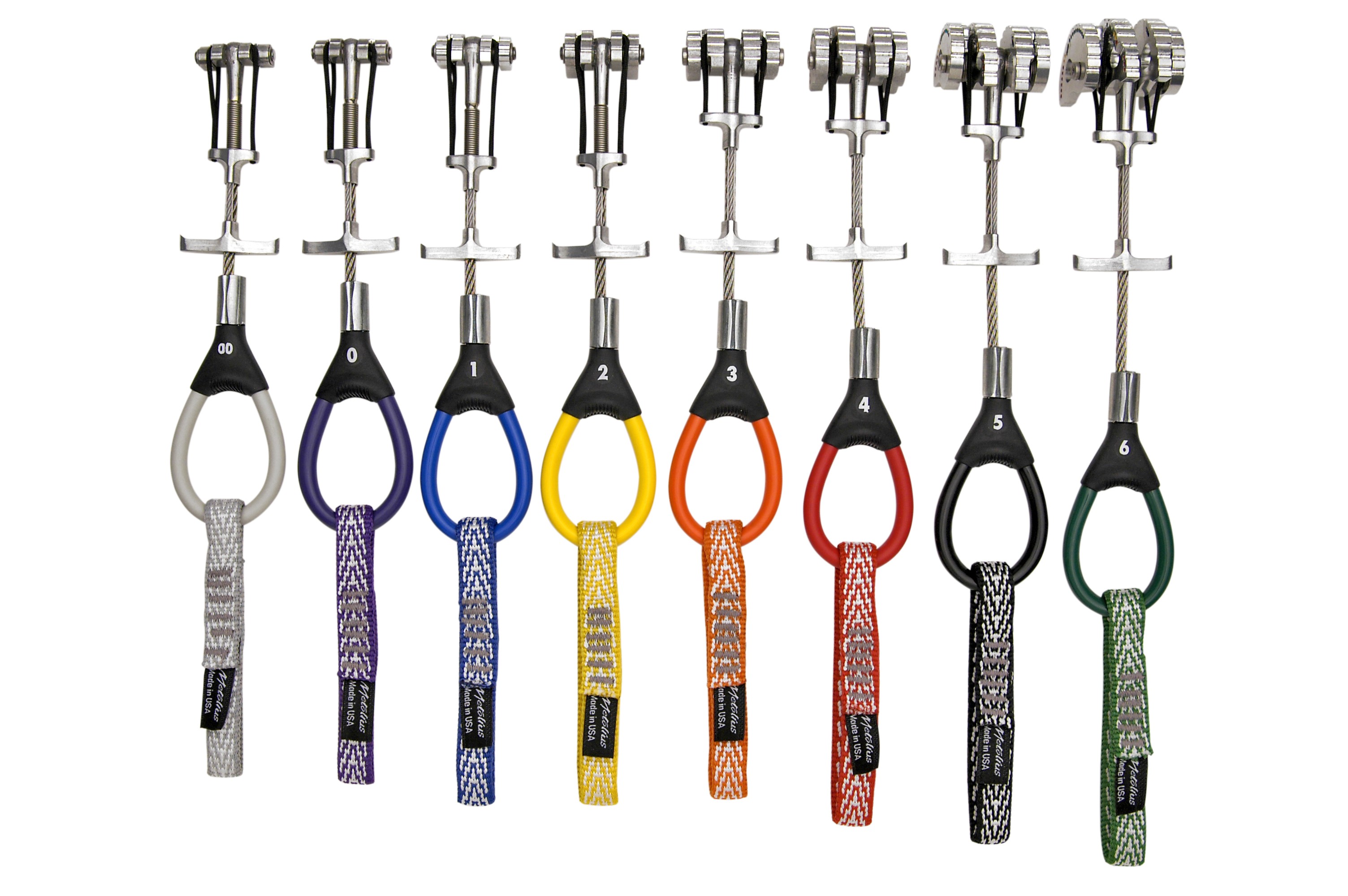
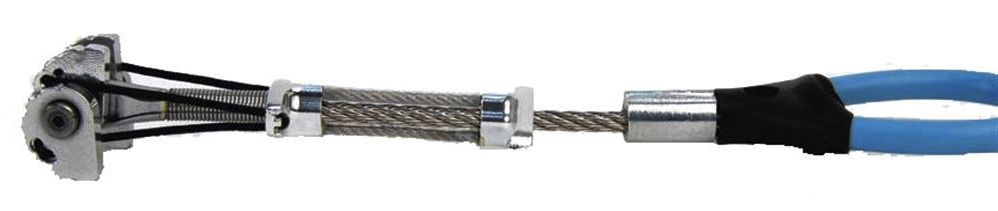
The Metolius #0, #00 have to use a smaller axle size just to be able to hold the cam lobes themselves. These smaller axles, although optimized through heat treating, still just don’t have enough size/ mass to withstand even moderate falls. The axle ends up bending (under a load/fall) and if it bends enough, the unit will pullout. These smaller units should be looked at as really only suitable for body weight applications or given enough time and judgment, accumulated over many years of experience…they may be used to hold falls…but the falls had better be small or you will pullout/destroy the unit.
When using micro gear, the order of the day is to place many backup pieces…so that if you blow out the top two, the third backup piece may hold your fall. Sometimes you will place up to 5 or 6 backup pieces above a crucial crux section (& know that you have some full strength pieces below those should they all fail!) Retreat is (almost) always an option! And for the beginning /intermediate climbers the wise one. Only seasoned experts have the judgment to gun for the anchors when running it out over micro gear. And even they must carefully weigh all the consequences and determine what if the piece(s) do pull, what will I hit, is it a clean fall, etc?
So units that are rated below 9kN aren’t necessarily aid pieces, but as pieces in the equipment chain get smaller and smaller…the consequences of their integrity should be heavily questioned. And at a certain point…the smallest pieces (micro gear) should really be thought of as able to hold body weight only (or referred to as aid pieces) – for safety’s sake!






Beefy and 170lbs in the same sentence?? Give me a break! Unless this dude is 5’5″ or something, 170 is NOT beefy.
heehee, there you have the Smith Rocks climber definition of beefy….
Nice!
That confirms that a RP/Astronut would likely not take a leader fall.
That confirms also my own experience:
I caught a climber on a RP, it was his first piece.
His RP (fixed piece) was backed up by an Alien.
The cable of the RP broke and the Alien held.
Haha yeah I’m 170 and I’m skinny, but I am 6′.
Regardless, great post Steph. I always wondered about those small pieces myself.
Once took an unexpected fall above two well placed, equalized micro-cams (blue & gray Aliens) only to have them both rip like a hot knife thru butter. Result: what should’ve been a ten foot fall suddenly became a clean but scary 30+ footer.
Are you saying the cam lobes get smushed to the point where the until is not longer caming in the crack? Would that mean the strength rating would actually be higher if you placed the cam in a constiction?
Also, is there any validity to the logic of placing a tiny piece as sort of a “screamer” in order to at least slow you down, or would you just pick up speed the instant it popped?
yikes.
🙂
that’s scary.
i don’t think the gear gets squished, but I think a lot of this is also very dependent on the type of rock (think granite vs. limestone vs. sandstone). But that is a great question about the constriction. I think what Brooke was saying is that when the material becomes less (due to smaller size of an object), that its breaking strength is also less.
Still, a well placed tiny cam in good rock will hold a fall–but you can trust it to a different degree than a hand-sized cam in the same rock….
Great article!! Thanks for clarifying that. I’ve always wondered about the two tinniest Metolius for holding falls.
me too! 🙂
“…but the falls had better be small”
I know what you meant, but just to clarify – the falls better be low impact. even a 3 foot fall with very little rope out (or heaven forbid, you’re clipped in with a sling) can produce extremely high FF and force. At the same time a 20 foot fall with most of the rope out produces very little force. Might not even engage a screamer (I’ve seen it).
Joining in kind of late but here goes: 5kN will hold a lead fall if the rock is sound. I can understand why a gear manufacturer would be cautious and err on the side of being ultra conservative, but it is simply not accurate to describe a 0 or 00 Metolius cam as “body weight gear.”
There are many factors that affect force in a fall, including the elasticity of the rope. I’ve fallen on 4kN pieces, and they’ve held fine. After holding a lead fall a rope stretches out and loses much of its elasticity. After falling on a piece rated for 4kN, I would recommend tying into the other end of the rope before risking another fall. But in my experience, a 5kN cam such as a 0 or 00 Metolius will hold a lead fall, and even repeated falls, if placed well in sound rock.